Introduction
Introduction to Suryodaya Municipality
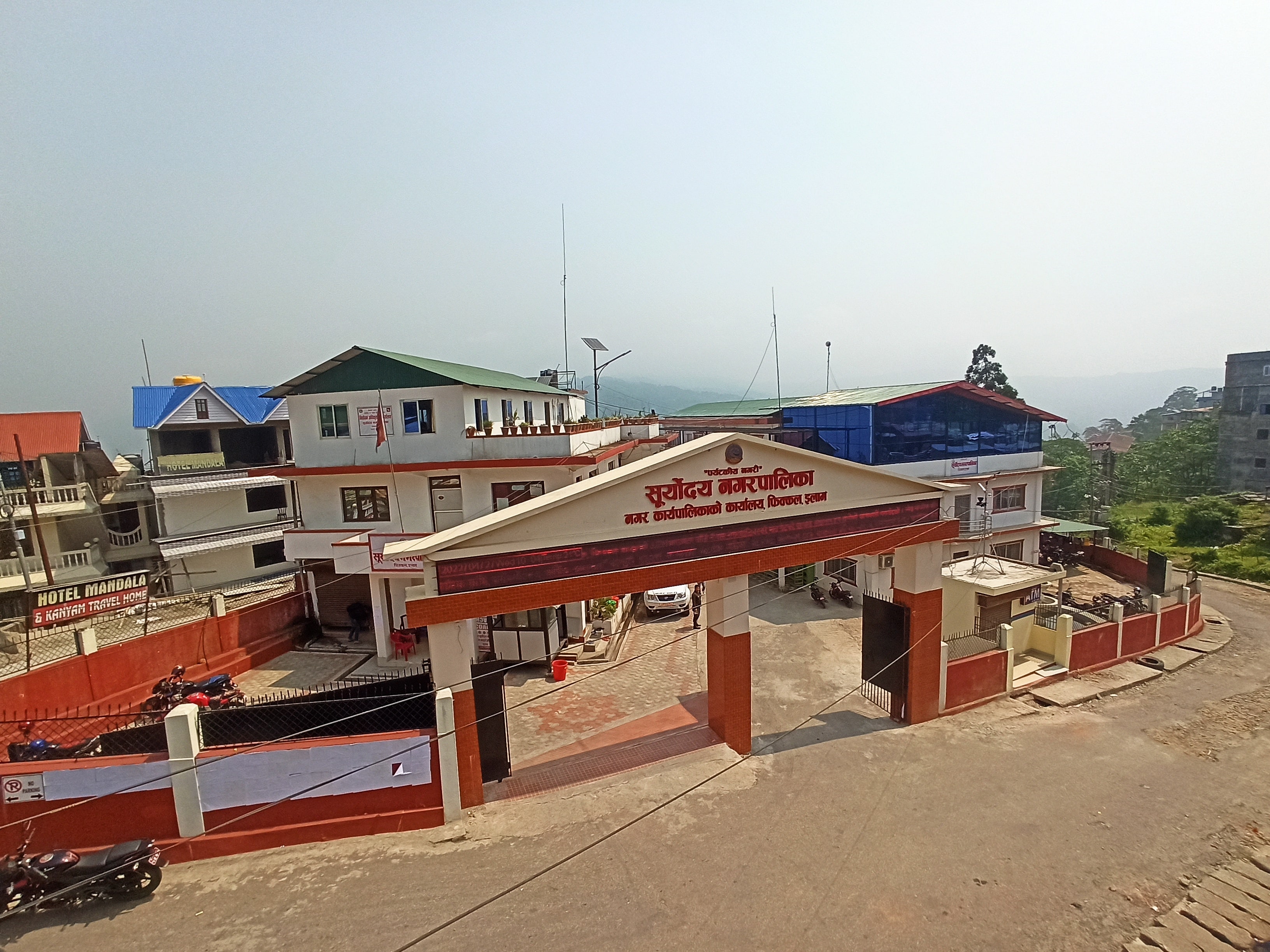
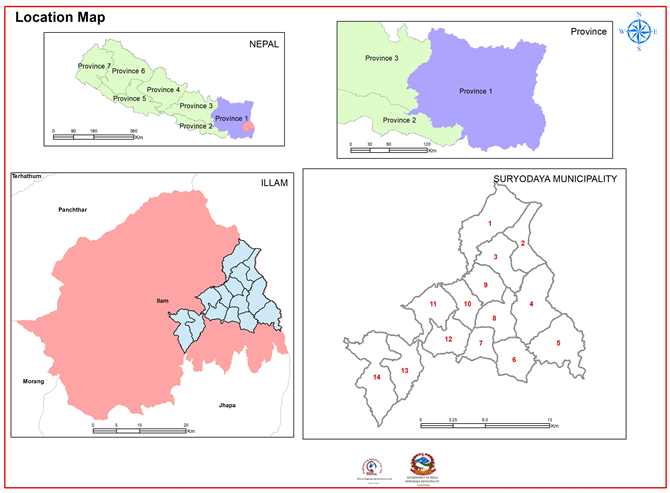
Suryodaya Municipality, with its name being the Nepali translation of “ Rising Sun “was formed in 2013, with the merger of village Development Councils of Fikkal, Panchakanya, and Kanyam. After the constitution of Nepal was promulgated in 2015, more village development councils had been merged including Gorkhey, Pasupatinagar, Sriantu, Samalbung, Laxmipur, and Jogmai Word no. 8 and 9, and have resulted in the increase of its area span, with now, it’s size being 252.52 sq. km. It is located center part of the Ilam district. Darjeeling west bangle is in the east, Ilam municipality in the South, Rong Village council in the North, and Mai Municipality in the Northwest. it has three transit points with India including Pasupaitinagar, Chhabise, and Manebhanjang.
Geographically, it lies in the hill region, mostly known as the Mahabharat range with natural scenery and pleasant weather.
Populated with fifty-seven thousand people, it has fourteen words and more than forty-two thousand voters, and a very high literacy rate. The Municipality’s head office is located in Fikkal Bazaar, on whose outskirt is the famous tourist destination of India, Darjeeling. Thus, the Municipality has a very good trade relationship with the place, since the most vital and famous agriculture destination of East Nepal. It is famous for agricultural products like Potato, Milk, Cardamon, Chayote, Ginger, Broom Gress, and Round Chillies.
Suryodaya Municipality has a great possibility for tourism.
Location Map
Long Term Vision

"Prosperity of Suryodaya Municipality: Organic Agriculture, Eco-tourism and Economic Equity".
Mission

By adopting the municipal policies as a guide, conduct activities as directed by the "SURYODAYA Development Module" and provide local government guarantees to the residents.
Goal

In the activities conducted by the municipality, progress will be achieved according to the set goals in terms of time, cost, quality, and quantity, and the living standards of the citizens will be improved by increasing the economic, social, physical, environmental, institutional service delivery, financial management and good governance of Suryodaya Municipality.
Objectives

- Increasing commercial agricultural production and productivity
- To prepare the foundation of economic and social development including tourism through environmentally friendly infrastructure development Making life safer through sustainable
- Use of natural resources and disaster management
- Enhancing government governance
- Achieving high economic growth through the development of skilled human resources, expanded employment, and gender equality
- Adopt Child-friendly local governance.
Promise

Leaving No One Behind.
Jurisdiction
Local government operation, development, and service delivery are the main functions at the local level. The purpose of the municipal executive office is to carry out the following tasks in the following areas to achieve the objectives of the municipality.
Local Governance: Management of City Councils, Management of Local Executives, Management of Judicial Committees, Policy Making, Law Making, Budget Formulation
Local Development: Implementation of plans and programs related to local development within the scope of plans, programs, and budgets approved by the City Council, implementation of transferred programs.
Service delivery: According to the Local Government Operation Act, 2074, service delivery in the areas of work duties and rights of local level and ward offices
Major functions
Provisions in the Constitution of Nepal
Clause (4) of Article 57: The authority of the local level shall be by the laws made by the Municipal Assembly on the matters mentioned in Schedule 8.
Clause (2) of Article 214: The local executive powers shall be as mentioned in the list as per Schedule - 8 and Schedule - 9.
Sub-section (2) of Article 221: The managerial authority of the Municipal Assembly shall be as mentioned in the list by Schedule-8 and Schedule-.
Sub-section (1) of Article 226: The Municipal Assembly can enact necessary laws on matters mentioned in the list as per Schedule-8 and Schedule-9. (According to the procedure prescribed by the state law)
According to Schedule-8 of the Constitution of Nepal, the main areas of work at the local level are as follows:
- City Police
- Co-operative Societies
- FM operation
- Local tax
- Management of local services
- Compilation of local statistics and records
- Local-level development projects and projects
- Primary and Secondary Education
- Primary health and hygiene
- Local market management, environmental protection, and biodiversity
- Local roads, rural roads, agricultural roads, irrigation
- Management of municipal assemblies, local courts, conciliation, and arbitration
- Local records management
- Distribution of real estate assets
- Agriculture and animal husbandry, agricultural production management, animal health, cooperatives
- Management of senior citizens, persons with disabilities, and the disabled
- Compilation of unemployment statistics Management, operation, and control of agricultural extension
- Water supply small hydropower projects, alternative energy
- Disaster management
- Conservation of water, wildlife, mines, and minerals
- Preservation and development of language, culture, and fine arts
* Section 11 of the Local Government Operation Act, 2074 mentions the areas of work to be done at the local level.